The Business of Non-Profits
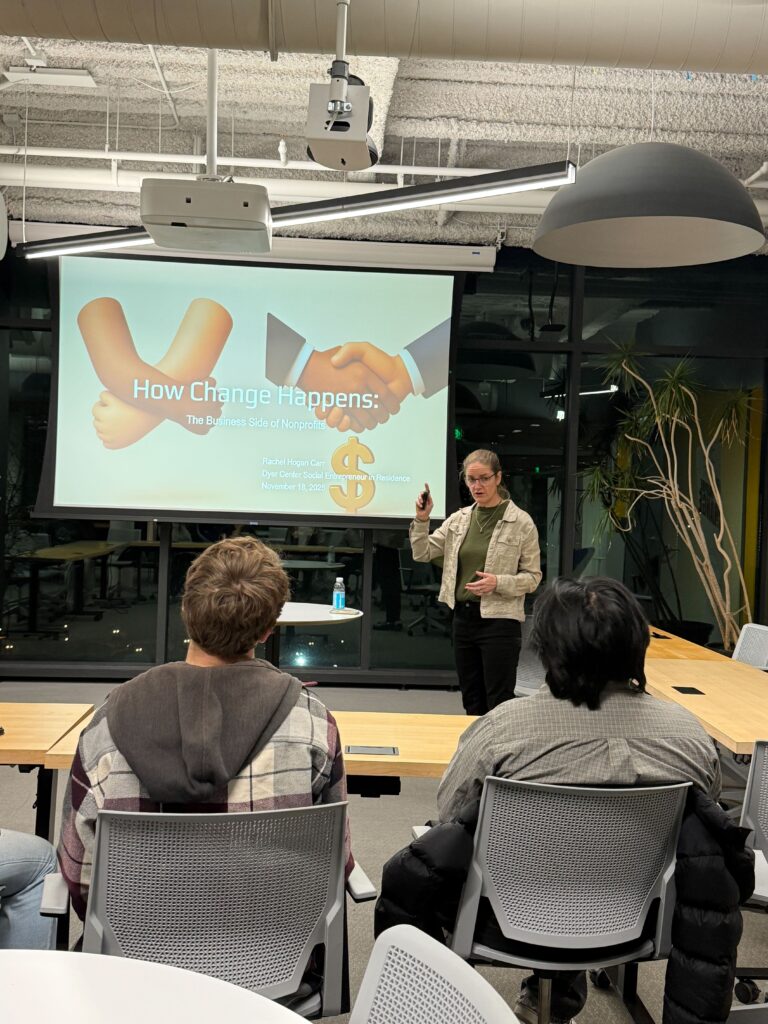
As the Co-founder and Executive Director of the Nurture Nature Center—a nationally recognized organization founded in the wake of the devastating Lehigh Valley floods—Rachel brought real-world experience to the conversation. Her talk moved beyond the “why” of social change to the critical “how,” focusing on the often-overlooked financial engines that power mission-driven organizations.
Key Takeaways:
- The Symbiotic Loop: Rachel emphasized that mission and business are not separate entities. Instead, she described a “symbiotic loop” where revenue models influence activities, and outcome evaluations support future revenue generation. Understanding this loop is critical for any social entrepreneur.
- Defining Success (Ends vs. Means): Students were introduced to a powerful framework for articulating impact. Rachel distinguished between Ends (the outcomes, e.g., “Residents have the ability to make informed medical decisions”) and Means (the methods, e.g., “We provide training programs”). She noted that while means might change to become more effective, the Ends define the organization’s identity.
- The Revenue Mix: The session broke down the complex landscape of non-profit funding, from the stability of endowments to the flexibility of individual donors and the potential “mission drift” risks associated with earned income.
Why It Matters: For students looking to solve societal problems, the lesson was clear: having a solution is only half the battle. As Rachel noted, whether you are relying on grants, corporate contributions, or earned income, “You work for it either way”. Mastering the business side—accountability, fiscal transparency, and data-driven storytelling—is what turns a good idea into a sustainable force for change.
We want to thank Rachel for sharing her expertise and helping our students understand that in the world of non-profits, financial sustainability is the foundation of lasting impact.